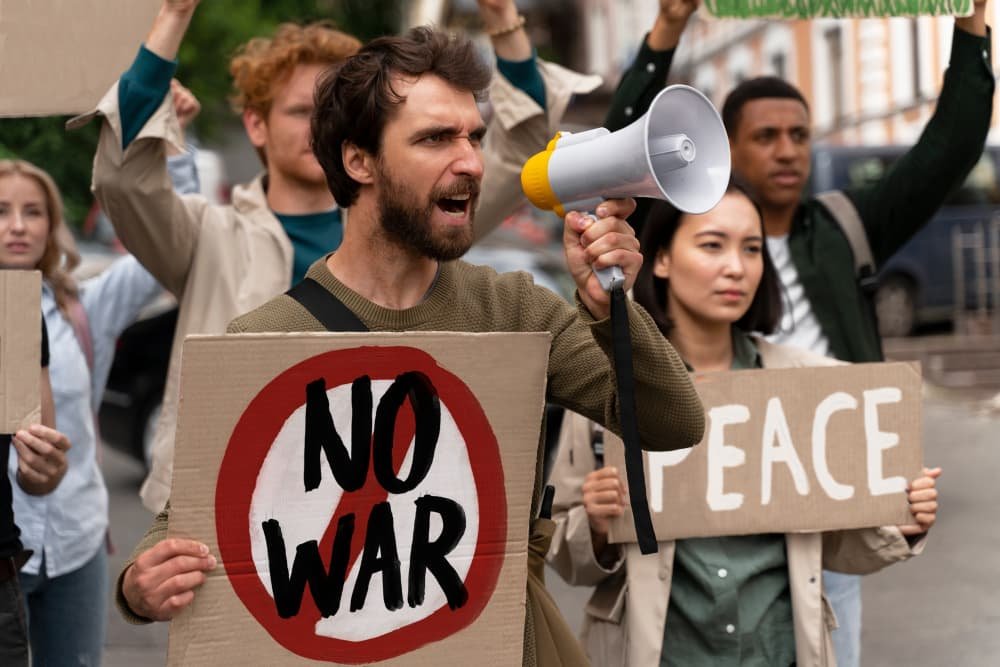
As we close out 2025, the landscape of American activism has shifted dramatically. While the First Amendment technically remains the “bedrock” of our democracy, a wave of new state and federal laws—often referred to as the “Campus Protection” or “Anti-Disruption” movement—has rewritten the rules for when, where, and how you can raise your voice.
If you participated in the historic “No Kings” protests in October 2025 or have been active in campus walkouts this year, you’ve likely seen law enforcement and university officials use a new playbook of restrictions. Understanding these legal “grey areas” is the only way to ensure your activism doesn’t result in a criminal record.
The 2025 Trend: The End of the “Traditional Public Forum”?
For decades, sidewalks, parks, and plazas were considered “traditional public forums” where free speech was at its peak. However, 2025 has seen a concerted effort to shrink these spaces.
-
Texas SB 2972 (The Campus Protection Act): Signed in June 2025, this law notably eliminated the requirement that common outdoor areas of public universities be considered traditional public forums. It effectively allows administrations to ban encampments, nighttime “expressive activity,” and even the wearing of masks during protests.
-
The Federal “Stop FUNDERS” Act: Introduced in late 2025, this legislation seeks to use the RICO Act to prosecute individuals and organizations that fund or coordinate protests deemed to be “riots.” By targeting the “money” behind the movement, this law creates a significant chilling effect on grassroots organizing.
-
Anti-Traffic Obstruction Laws: New federal and state penalties (such as HR 4015) have turned “blocking a highway” into a serious federal offense, moving away from the minor citations of the past toward potential prison time and deportation for non-citizens.
“Time, Place, and Manner”: The Legal Trap
The government is allowed to place “reasonable” restrictions on speech, provided they are content-neutral. However, in 2025, these Time, Place, and Manner (TPM) restrictions are being used as surgical tools to neutralize the impact of protests.
-
Time Limits: Policies like the University of Virginia’s updated guidelines now prohibit all outdoor events between 2:00 a.m. and 6:00 a.m., effectively ending the era of 24/7 protest vigils.
-
Place Restrictions: Schools like Columbia and UCLA have implemented “designated zones” for protests, often pushing activists to the edges of campus where they cannot be seen or heard by the decision-makers they are trying to influence.
-
Manner Prohibitions: The banning of “amplified sound” (microphones, bullhorns, or drums) is now a standard tactic. If your protest is “too loud” for a classroom or office, it can be declared a “disruptive event” and shut down legally.
Tutorial: How to Protect Your Legal Rights While Protesting
If you are planning to engage in activism, you must prepare for a legal system that is increasingly hostile to “disruption.”
-
Document the “Notice”: Many 2025 policies, like those at Columbia, require “spontaneous” demonstrations to provide notice the moment they begin. Use your phone to document that you attempted to follow these procedures.
-
Ask for the “Specific Disruption”: If police or administrators tell you to move, ask exactly what ordinance or “manner” restriction you are violating. If they cannot name one, they may be engaging in viewpoint discrimination, which is illegal.
-
Record the Police Response: Under the First Amendment, you have the right to film police in public. In 2025, this is critical evidence to prove that a “dispersal order” was given without a “clear, unobstructed exit path”—a common violation this year.
-
Know Your Standing: Private universities are not bound by the First Amendment in the same way public ones are. If you are on private property, your rights are based on the student handbook or contract, not the Constitution.
Conclusion
The right to protest is not a static privilege; it is a muscle that must be defended every time it is flexed. As we head into 2026, the transition from “protected assembly” to “criminal disruption” has become a matter of minor technicalities—a mask, a bullhorn, or a tent can now be the difference between a successful rally and an arrest record. Proving that your activism was a protected exercise of free speech rather than a violation of protest rights in 2025 requires more than just passion; it requires a strategic legal defense for activists who can challenge the narrow “Time, Place, and Manner” restrictions currently being used to silence dissent. If you have been arrested, suspended, or threatened with prosecution for your political expression, you need a First Amendment lawyer in the USA who understands the latest 2025 state and federal precedents. To protect your record and your right to speak out, contact Lforlaw today to connect with expert attorneys who specialize in defending the front lines of American democracy.
Sources
-
Freedom Forum: First Amendment Stories of 2025: A Year in Review (Dec 23, 2025).
-
The Free Speech Center (MTSU): New Texas Law Restricting Expressive Activity on Campuses (July 2025).
-
ICNL US Protest Law Tracker: 2025 Update on Federal RICO and Traffic Obstruction Bills.
-
Foundation for Individual Rights and Expression (FIRE): 2025 Record for Attempts to Silence Student Speech.
-
ACLU: Know Your Rights – Protesters’ Rights (Updated Oct 2025).