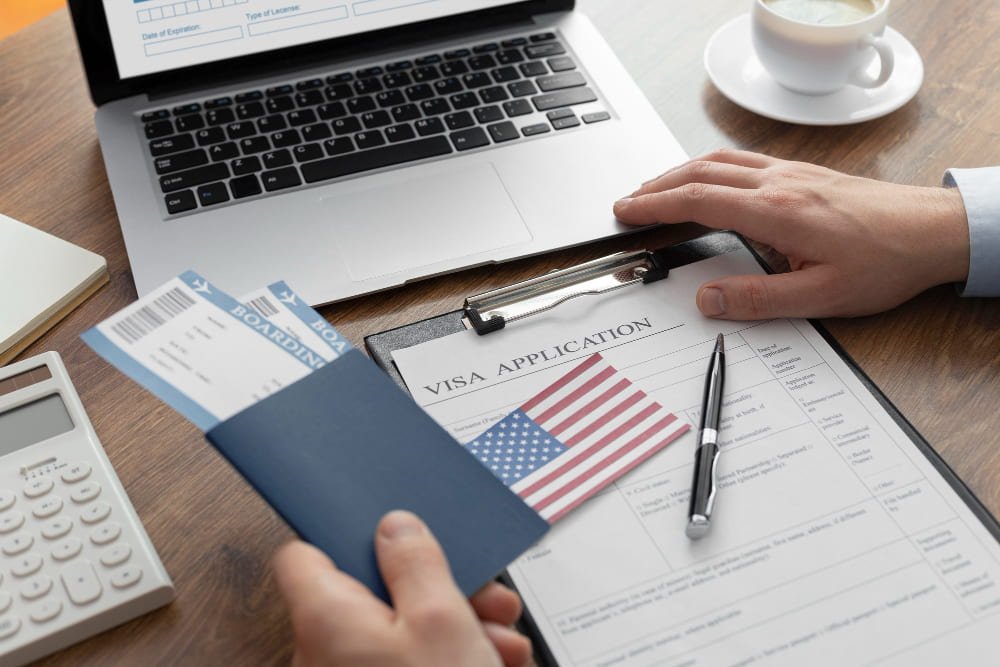
The H-2B visa program provides a pathway for U.S. employers or their designated representatives to employ foreign nationals in temporary, non-agricultural roles. To participate, the U.S. employer or agent must adhere to specific regulations and submit Form I-129, Petition for a Nonimmigrant Worker, on behalf of each potential temporary worker.
Eligibility for H-2B Nonimmigrant Status
To qualify for the H-2B visa, the petitioning employer must demonstrate that:
-
No Qualified U.S. Workers: There are not enough U.S. workers who are available, willing, qualified, and able to perform the temporary work.
-
No Adverse Impact: Hiring H-2B workers will not negatively affect the wages and working conditions of similarly employed U.S. workers.
-
Temporary Need for Services: The employer’s need for the prospective worker’s services or labor is temporary, regardless of whether the job itself is temporary. A temporary need is defined as:
- One-Time Occurrence:
- An otherwise permanent employment situation where a short-term, temporary event creates the need for a worker.
- The employer has not employed and will not need workers for this service or labor in the past or future.
- Seasonal Need:
- The service or labor is traditionally tied to a specific season or event and is recurring.
- Note: You cannot claim a seasonal need if the off-season period is unpredictable, subject to change, or considered a vacation for permanent employees.
- Peak Load Need:
- The employer regularly employs permanent staff for the work.
- There is a need to temporarily supplement the permanent staff due to a seasonal or short-term demand.
- The temporary additions will not become part of the employer’s regular operations.
- Intermittent Need:
- The employer does not employ permanent or full-time workers for the service or labor.
- Temporary workers are needed occasionally or intermittently for short periods.
- One-Time Occurrence:
Labor Certification Requirement:
All H-2B petitioners must provide a valid temporary labor certification from the U.S. Department of Labor (DOL). If the workers will be employed in Guam, the certification must be from the Guam Department of Labor (Guam DOL).
H-2B Visa Cap and Numerical Limits
The number of foreign workers who can be granted H-2B visas or status each fiscal year is limited by a statutory cap. Currently, Congress has set this annual H-2B cap at 66,000. This is divided into two halves: 33,000 visas are allocated for workers starting employment in the first half of the fiscal year (October 1 to March 31), and another 33,000 are for those starting in the second half (April 1 to September 30).
Any unused H-2B numbers from the first half of a fiscal year become available for employers seeking workers in the second half. However, any remaining numbers at the end of a fiscal year do not carry over to the next.
Once the annual H-2B cap is reached, USCIS can only accept petitions for H-2B workers who are exempt from this numerical limit. For the latest information on the H-2B cap and details about exempt workers, please refer to the “Cap Count for H-2B Nonimmigrants” webpage.
The H-2B Petition Process
Step 1: Obtain Temporary Labor Certification from the Department of Labor (DOL)
Before petitioning USCIS for H-2B classification, the employer (petitioner) must first apply for and receive a temporary labor certification for H-2B workers from the U.S. Department of Labor. If the employment will be in Guam, the certification must be obtained from the Guam Department of Labor (Guam DOL). For detailed information on the requirements and process for the temporary labor certification application, please refer to the Foreign Labor Certification webpages of the U.S. Department of Labor and the Guam Department of Labor.
Step 2: File Form I-129 with USCIS
Once the temporary labor certification is approved by either the DOL or the Guam DOL (as applicable), the petitioner must then file Form I-129, Petition for a Nonimmigrant Worker, with USCIS. Generally, the original temporary labor certification must be submitted along with Form I-129 (refer to the Form I-129 instructions for specific filing requirements). If the labor certification was processed through the DOL’s FLAG system, the petitioner must include a printed copy of the one-page electronic “final determination” of the H-2B temporary labor certification approval with Form I-129. USCIS will accept this printed copy as the original and approved temporary labor certification. If the original labor certification has already been submitted with a previous Form I-129, a copy should be included with the current petition, along with an explanation that includes the receipt number of the previous petition if available.
Step 3: Prospective Workers Apply for Visa and/or Admission
After USCIS approves Form I-129, prospective H-2B workers who are outside the United States must take one of the following actions:
- Apply for a Visa and Seek Admission: Apply for an H-2B visa at a U.S. Embassy or Consulate abroad with the U.S. Department of State (DOS) and then seek entry into the United States with U.S. Customs and Border Protection (CBP) at a U.S. port of entry.
- Seek Direct Admission (if no visa required): Directly seek admission to the United States in H-2B classification with CBP at a U.S. port of entry in cases where an H-2B visa is not required.
Impact of Prior Violations
Effective January 17, 2025, USCIS has the authority to deny H-2B petitions filed on or after this date if the petitioning employer or its previous entity has been found to have committed specific serious labor law violations or otherwise violated the requirements of either the H-2A or H-2B program. This potential denial applies to both H-2 visa classifications, regardless of whether the violation occurred in the H-2A or H-2B program. The decision to deny a petition will be either mandatory or discretionary, depending on the nature of the past violation(s). For further details, please refer to 8 CFR 214.2(h)(10)(iv) and the Form I-129 instructions.
Liability for Past Violations:
For the purpose of this denial authority, a criminal conviction or a final administrative or judicial determination against certain individuals will be considered a conviction or final determination against the petitioning employer or its successor in interest. More information on this can be found in 8 CFR 214.2(h)(10)(iv)(C).
Determining Successor in Interest:
USCIS’s process for determining whether an employer qualifies as a successor in interest is outlined in 8 CFR 214.2(h)(6)(i)(D).
Prohibition of Fees for H-2B Workers
As a condition for approving an H-2B petition, employers are strictly prohibited from collecting any job placement fees, fees or penalties for breach of contract, or any other direct or indirect fees, penalties, or compensation related to the H-2B employment (collectively, “prohibited fees”) from the H-2B worker or anyone acting on their behalf.
Prohibited fees include, but are not limited to, deductions or withholding of wages or salary, regardless of whether the worker benefits from such deductions. Passing on costs to the worker that, by law or regulation, are the employer’s responsibility also constitutes a prohibited fee. For more details, please refer to 8 CFR 214.2(h)(6)(i)(B)-(D) and the Form I-129 instructions.
Consequences of Collecting Prohibited Fees:
USCIS will deny or revoke an H-2B petition if it is determined that the employer, or any of their employees, agents, attorneys, facilitators, recruiters, employment services, or joint employers, collected or agreed to collect prohibited fees, whether before or after the petition was filed. For information on limited exceptions to mandatory denial or revocation for prohibited fees, see 8 CFR 214.2(h)(6)(i)(B)-(D) and the Form I-129 instructions.
Denial of Future Petitions:
If USCIS denies or revokes a petition due to prohibited fees, or if the employer withdraws the petition after being notified of intent to deny or revoke for this reason, USCIS will take the following actions regarding future H-2A or H-2B petitions filed by the same employer or their successor in interest:
- Within 1 Year: Any H-2A or H-2B petition filed within one year after the denial, revocation, or withdrawal (if the original petition was filed on or after January 17, 2025) will be denied.
- Additional 3 Years: For an additional three years after the initial one-year period, any H-2A or H-2B petition filed by the employer or their successor in interest will also be denied unless all affected workers, or their designated representatives, have been fully reimbursed.
This denial policy applies to petitions for both H-2A and H-2B classifications, regardless of the program in which the initial denial, revocation, or withdrawal occurred. The 3-year denial period applies to employers whose petitions were denied, revoked, or withdrawn after being filed on or after January 17, 2025. For further information, including how successor in interest is determined and the process for reimbursing designees, consult 8 CFR 214.2(h)(6)(i)(B)-(D) and the Form I-129 instructions.
H-2B Visa Duration and Time Limits
USCIS typically grants H-2B classification for the duration specified on the approved temporary labor certification. H-2B status can be extended in increments of up to one year, provided a new, valid temporary labor certification covering the requested extension period is submitted with each request. However, the maximum total period of stay in H-2B classification is three years.
Individuals who have held H-2B status for a cumulative total of three years must depart and remain outside the United States for an uninterrupted period of at least 60 days before they can seek readmission as an H-2B nonimmigrant. Furthermore, time spent in other H or L nonimmigrant classifications is counted towards this three-year maximum.
Resetting the Three-Year Limit:
An uninterrupted absence from the United States for at least 60 consecutive days at any point will allow an H-2B worker to become eligible for a new three-year maximum period of H-2B stay. Brief trips to the U.S. for business or pleasure during this 60-day period do not interrupt the required absence but also do not count toward fulfilling it.
Documentation Requirements:
To demonstrate compliance with the 60-day absence requirement, the petitioning employer must provide evidence documenting the worker’s relevant absences from the United States. Acceptable evidence includes, but is not limited to, arrival and departure records, copies of tax returns, and records of employment outside the U.S.
H-4 Status for Family Members of H-2B Workers:
- Spouses and unmarried children under 21 years of age of an H-2B worker can seek admission to the U.S. in H-4 nonimmigrant classification.
- H-4 status does not allow for employment in the United States.
Employment Notification Requirements for Petitioners (OMB Control Number 1615-0107)
Employers (petitioners) who sponsor H-2B workers are required to notify USCIS within two workdays of any of the following events:
- Worker No-Show: The H-2B worker fails to report for work within five workdays of the employment start date on the approved H-2B petition.
- Worker Abandonment: The H-2B worker leaves the job without notice and does not return to work for five consecutive workdays without the employer’s consent.
- Early Termination: The H-2B worker’s employment is terminated before the completion of the labor or services specified in the H-2B petition.
- Early Completion: The H-2B worker completes the labor or services more than 30 days before the end date stated in the H-2B petition.
Note: USCIS follows the Department of Labor’s (DOL) definition of “workday,” which, according to the Fair Labor Standards Act (FLSA), is generally the time period when an employee begins and ends their primary job activities.
Required Information for Notification:
Petitioners must include the following details in their employment-related notification:
- The reason for the notification (e.g., “worker never reported,” “worker stopped reporting,” “termination,” or “early completion”).
- Explanation for any late notification and evidence of good cause, if applicable.
- The USCIS receipt number of the approved H-2B petition.
- Petitioner’s information:
- Name
- Address
- Phone number
- Employer Identification Number (EIN)
- Employer’s information (if different from petitioner):
- Name
- Address
- Phone number
- H-2B worker’s information:
- Full name
- Date of birth
- Place of birth
- Last known physical address and phone number
- Optional, but helpful, worker information:
- Social Security number
- Visa number
Important Notes:
- This notification is a petitioner’s obligation and does not imply any wrongdoing by the H-2B worker.
- USCIS does not consider the information provided in the notification as conclusive evidence of the worker’s current status.
How to Notify USCIS:
Petitioners must email or mail their notification to the USCIS Service Center that approved the I-129 petition. Email notification is strongly recommended for timely submission.
- California Service Center:
- Email: [email address removed]
- Mail: USCIS California Service Center, P.O. Box 30113 / ALL OTHER (Attn: BCU Section), Tustin, CA 92781
- Vermont Service Center:
- Email: [email address removed]
- Mail: Vermont Service Center, Attn: BCU ACD, 38 River Road, Essex Junction, VT 05479-0001
Exemption from Temporary Need Requirement
The National Defense Authorization Act for Fiscal Year 2018 (FY 2018 NDAA) established an exemption for specific H-2B petitioners located in Guam and the Commonwealth of the Northern Mariana Islands (CNMI). This exemption waives the standard requirement to demonstrate that the need for the H-2B worker is temporary. Subsequent National Defense Authorization Acts have extended and modified this initial exemption.
For detailed information and guidance on qualifying for this exemption, please refer to Volume 2, Part I, Chapter 11 of the USCIS Policy Manual.
Conclusion
To ensure compliance and streamline your application, we strongly recommend seeking expert guidance from our experienced immigration professionals. Our team is equipped to provide tailored assistance, helping you understand the intricacies of these regulations and avoid potential pitfalls.